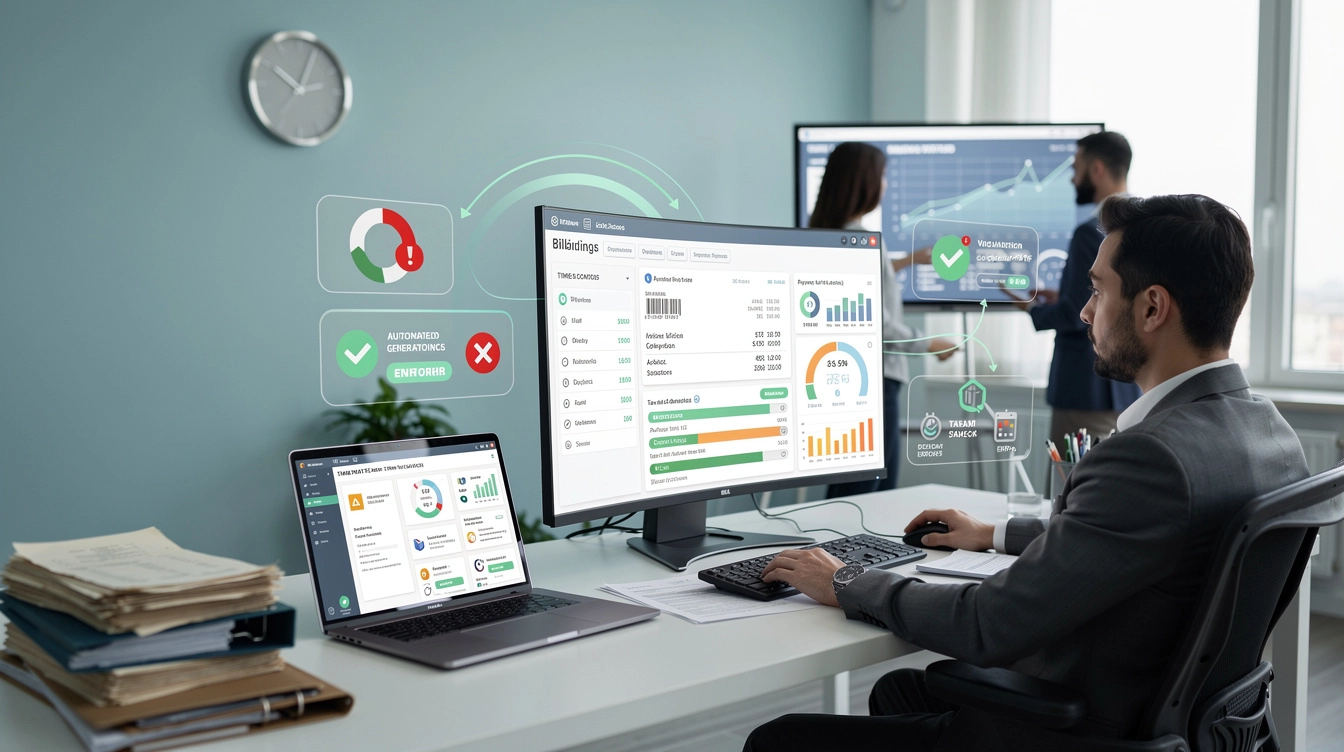
Modern businesses face mounting pressure to streamline financial processes whilst maintaining accuracy in their billing operations. The traditional approach of manual invoice generation, payment processing, and financial record-keeping has become increasingly unsustainable as organisations scale and client demands evolve. Billing software represents a transformative solution that addresses these challenges through sophisticated automation, validation protocols, and integrated workflows that dramatically reduce human error whilst accelerating processing times.
The financial implications of billing errors extend far beyond simple administrative inconvenience. Recent industry research indicates that businesses lose an average of 5-7% of their annual revenue due to billing inaccuracies, delayed invoicing, and payment processing delays. These losses compound when considering the additional costs associated with dispute resolution, client relationship management, and regulatory compliance issues. Contemporary billing software platforms have emerged as comprehensive solutions that not only eliminate these costly inefficiencies but also provide strategic advantages through enhanced financial visibility and automated compliance frameworks.
Automated invoice generation and processing systems
The foundation of modern billing efficiency lies in automated invoice generation systems that eliminate manual data entry and standardise processing workflows. These platforms transform what was once a time-consuming, error-prone manual process into a streamlined, accurate operation that can handle thousands of transactions with minimal human intervention. The automation extends beyond simple template filling to encompass complex calculations, tax computations, and compliance checks that traditionally required significant manual oversight.
Advanced billing platforms integrate seamlessly with existing business systems, automatically pulling customer data, product information, and pricing structures to generate accurate invoices in real-time. This integration eliminates the need for duplicate data entry across multiple systems, reducing the likelihood of discrepancies and ensuring that all invoice components reflect the most current information available. The result is a dramatic reduction in processing time, with many organisations reporting invoice generation times reduced from hours to minutes.
Quickbooks pro Real-Time invoice creation workflows
QuickBooks Pro exemplifies the power of real-time invoice creation through its intelligent workflow automation capabilities. The platform monitors transaction triggers and automatically initiates invoice generation based on predefined business rules, ensuring that billing occurs promptly without manual intervention. This real-time processing capability means that service completion or product delivery immediately triggers the invoicing process, eliminating delays that can impact cash flow and client relationships.
The system’s advanced workflow engine incorporates sophisticated logic that handles complex billing scenarios, including milestone-based invoicing, recurring charges, and variable pricing structures. Users can configure custom automation rules that reflect their specific business processes, ensuring that the platform adapts to unique operational requirements rather than forcing businesses to modify their established practices. This flexibility extends to approval workflows, where invoices can be automatically routed through designated approval chains based on amount thresholds or client categories.
Xero automated recurring billing templates
Xero’s automated recurring billing functionality transforms subscription-based and regular service billing from a repetitive manual task into an effortless automated process. The platform’s template system allows businesses to establish comprehensive billing patterns that accommodate various frequency requirements, from weekly service charges to annual maintenance contracts. These templates incorporate dynamic elements that automatically adjust for price changes, service modifications, or customer-specific terms without requiring manual intervention.
The sophistication of Xero’s recurring billing extends to handling complex scenarios such as pro-rated charges, temporary suspensions, and graduated pricing structures. The system automatically calculates appropriate charges based on service periods, applies relevant discounts or surcharges, and generates invoices with complete accuracy. This automation eliminates the common errors associated with manual recurring billing, such as incorrect date calculations, missed billing cycles, or inappropriate charge applications.
SAP business one integration with CRM platforms
SAP Business One’s integration capabilities with Customer Relationship Management platforms create a unified ecosystem where sales activities seamlessly translate into accurate billing processes. This integration ensures that contract terms, pricing agreements, and service specifications established during the sales process automatically flow into the billing system, eliminating potential discrepancies between what was sold and what is billed. The platform’s real-time synchronisation capabilities mean that any changes made in the CRM system immediately reflect in billing processes.
The integration extends to opportunity management, where potential sales can be converted into proforma invoices or preliminary billing estimates with a single click. This capability accelerates the sales-to-revenue cycle whilst ensuring that all contractual obligations are accurately captured in the billing system. The platform’s workflow automation can also trigger follow-up actions based on billing
automation tasks such as renewal notifications, contract reviews, or upsell prompts, ensuring that finance and sales teams remain aligned throughout the customer lifecycle.
By synchronising billing data with CRM records, SAP Business One also enhances reporting accuracy. Revenue forecasts, customer profitability analysis, and account-level margin reports draw from a single source of truth, rather than fragmented spreadsheets. This unified approach not only reduces errors but also saves time otherwise lost reconciling differences between departments. When every team works from the same data, disputes over pricing or entitlements decrease, and client conversations become more transparent and constructive.
Freshbooks API-Driven invoice distribution mechanisms
FreshBooks leverages API-driven invoice distribution to automate how invoices are delivered, tracked, and reconciled. Instead of downloading PDF files and manually attaching them to emails, the platform can push invoices directly to clients via email, client portals, or integrated payment platforms as soon as they are generated. This tight integration ensures that invoices are not only created correctly but also reach the right recipient at the right time, which is essential for improving cash flow.
The FreshBooks API allows businesses to connect billing workflows with project management, time-tracking, and CRM solutions. For example, when a project status changes to “completed” in a connected system, FreshBooks can automatically generate and send an invoice, log the transaction, and update the outstanding balance. This reduces the number of manual touchpoints where data might be mistyped or lost altogether. For organisations handling large volumes of small invoices, such as agencies or professional services firms, API-driven automation can save dozens of hours each month and significantly reduce billing errors.
Error reduction through digital validation and compliance frameworks
Whilst automation accelerates billing processes, its real value emerges when combined with robust validation and compliance frameworks. Digital validation layers act like an intelligent gatekeeper, checking each invoice against tax rules, contract terms, and accounting standards before it leaves your system. This reduces the likelihood of disputes, penalties, and rework, which are some of the most costly consequences of billing errors. In highly regulated environments, such as the UK’s Making Tax Digital (MTD) regime, these safeguards are no longer optional; they are essential.
Modern billing software embeds compliance controls into everyday workflows, rather than treating them as separate, ad hoc checks. From automated VAT verification to duplicate detection and multi-currency calculations, these platforms continuously scan transactions for anomalies. Think of it as having a digital auditor working in the background 24/7, catching mistakes that even the most experienced finance professionals might miss when under time pressure.
HMRC MTD VAT calculation verification protocols
Under HMRC’s Making Tax Digital requirements, VAT-registered businesses must maintain digital records and submit VAT returns using compatible software. Billing platforms that support MTD integrate VAT calculation verification directly into the invoicing process. As each invoice is created, the system applies the correct VAT rate based on product type, customer location, and applicable exemptions, then validates that the amounts match HMRC’s digital record-keeping rules.
These verification protocols help ensure that VAT returns compiled from billing software data are accurate and complete. Instead of manually checking VAT totals at the end of each quarter, you can rely on the system to flag inconsistencies in real time, such as zero-rated items incorrectly charged at standard rates. By eliminating last-minute reconciliation work and reducing the risk of VAT inspection issues, MTD-compliant billing software both saves time and provides peace of mind.
Sage 50cloud duplicate detection algorithms
Sage 50cloud incorporates duplicate detection algorithms designed to identify and prevent the creation of redundant or fraudulent invoices. When users attempt to enter an invoice with the same supplier, date, and amount as an existing record, the system issues a warning or blocks the entry altogether. This is particularly useful in organisations with multiple team members processing supplier bills, where the same document can easily be keyed in twice.
Beyond simple field matching, more advanced configurations assess patterns across invoice numbers, payment references, and purchase order links. This helps uncover near-duplicates or suspicious activities, such as slightly altered invoice numbers used to bypass manual checks. By stopping duplicate payments before they occur, Sage 50cloud not only reduces errors but also protects cash reserves and supplier relationships. You avoid the time-consuming process of requesting refunds and reconciling overpayments, which can otherwise drain finance team resources.
Wave accounting mathematical computation safeguards
Wave Accounting demonstrates how embedded mathematical safeguards can eliminate common calculation mistakes in small business billing. When you create an invoice, the platform automatically calculates line totals, subtotals, discounts, taxes, and grand totals with precision, removing the risk of spreadsheet formula errors or incorrect manual arithmetic. Even seemingly minor rounding issues can cause friction with customers; automated computation ensures consistent results across every document.
The system also validates that debits and credits balance correctly within the general ledger, reducing the likelihood of posting errors that distort financial statements. For businesses transitioning from manual methods, this alone can transform month-end close from a stressful, error-prone exercise into a straightforward routine. Instead of spending hours rechecking columns of numbers, finance staff can focus on reviewing the bigger picture and analysing performance trends.
Zoho books Multi-Currency exchange rate automation
Zoho Books provides multi-currency exchange rate automation that is crucial for organisations dealing with international clients and suppliers. Rather than manually looking up rates and entering them into each invoice, the system automatically pulls up-to-date exchange rates from trusted sources. It then converts amounts into the customer’s preferred currency and the business’s base reporting currency, ensuring consistent and accurate financial records.
This automation significantly reduces errors tied to outdated or inconsistent exchange rates, which can quickly erode margins or create reconciliation challenges. The platform also records the rate used at the time of invoicing, simplifying audit trails and compliance with accounting standards that require transparent disclosure of currency conversions. For finance teams, this means less time spent double-checking calculations and more confidence that cross-border billing is correctly handled.
MYOB AccountRight tax code compliance checking
MYOB AccountRight enhances tax compliance by enforcing tax code rules every time a transaction is posted. Each product or service can be assigned a default tax code, and the system automatically checks that the chosen code is valid for the customer type and jurisdiction. If a user attempts to apply an inappropriate tax treatment, such as GST on an export or incorrect exemptions, the software prompts for correction before the invoice is finalised.
These tax code compliance checks reduce the likelihood of underpayment or overpayment of tax, which can result in penalties, interest charges, or time-consuming amendments. As tax regulations evolve, MYOB updates its rulesets so that businesses remain compliant without having to track every legislative change manually. For growing organisations, this built-in intelligence acts like an always-current tax advisor sitting inside the billing software, catching issues in real time rather than after the fact.
Time-saving automation in payment processing and collections
Beyond invoice creation and validation, billing software delivers substantial time savings in payment processing and collections. Automated payment reminders, integrated payment gateways, and smart dunning workflows replace manual follow-up emails, phone calls, and reconciliation tasks. Instead of chasing overdue invoices one by one, you can rely on predefined rules to nudge customers at the right intervals and through their preferred channels.
Many platforms support features such as one-click payment links embedded directly in digital invoices, enabling customers to pay by card, bank transfer, or digital wallet without leaving the invoice screen. This frictionless experience improves the likelihood of on-time payment and reduces the administrative overhead associated with matching incoming payments to open invoices. For businesses with recurring revenue models, automated collections can be the difference between predictable cash flow and constant firefighting.
Real-time financial reporting and analytics dashboards
Modern billing software also functions as a powerful analytics engine, providing real-time dashboards that turn raw billing data into actionable insight. Rather than exporting figures into spreadsheets and building reports manually, you can access up-to-date metrics such as aged receivables, recurring revenue, average days to pay, and write-off rates at a glance. This on-demand visibility supports faster, more informed decision-making.
Interactive dashboards allow you to drill down from summary charts into individual invoices, customers, or product lines. For example, you might identify that a specific client segment is consistently late paying, or that a particular service line experiences frequent disputes. With this knowledge, you can adjust credit terms, refine billing descriptions, or improve internal processes. By reducing the time spent compiling reports and increasing the time spent acting on insights, analytics dashboards significantly enhance the strategic value of billing data.
Integration capabilities with ERP and accounting management systems
Integration is a cornerstone of effective billing automation. When billing software connects seamlessly with ERP and accounting management systems, data flows smoothly across the organisation without manual re-entry. Sales orders from ERP modules can generate invoices automatically, inventory adjustments happen in real time, and payment records sync back to the general ledger, ensuring that every system reflects the same financial reality.
These integrations often rely on standardised APIs and pre-built connectors, which reduce implementation time and ongoing maintenance. Instead of exporting CSV files or reconciling separate databases, finance teams can trust that customer balances, revenue recognition schedules, and tax postings remain aligned across platforms. This not only reduces errors but also frees up staff from repetitive integration tasks, allowing them to focus on analysis, forecasting, and process improvement. In effect, your billing software becomes a central hub within a wider digital finance ecosystem.
Cost-benefit analysis of manual versus automated billing workflows
When evaluating billing software, many organisations ask a simple question: does automation justify the investment? A structured cost-benefit analysis reveals that, in most cases, the answer is a resounding yes. Manual billing workflows carry hidden costs in the form of staff time, error correction, revenue leakage, and compliance risk. Industry studies frequently show that businesses can save 50–80% of the time currently spent on invoicing and collections by adopting automated billing solutions.
To quantify the benefits, you can compare current manual efforts—such as hours spent generating invoices, chasing late payments, and fixing mistakes—against subscription fees and implementation costs for billing software. Factor in the potential uplift in cash flow from faster invoicing and more reliable collections, along with reduced write-offs from overlooked invoices. When you also consider intangible gains like improved customer satisfaction, better audit readiness, and enhanced scalability as transaction volumes grow, the economic case for automation becomes even stronger. In many scenarios, the payback period for a well-implemented billing system is measured in months rather than years.