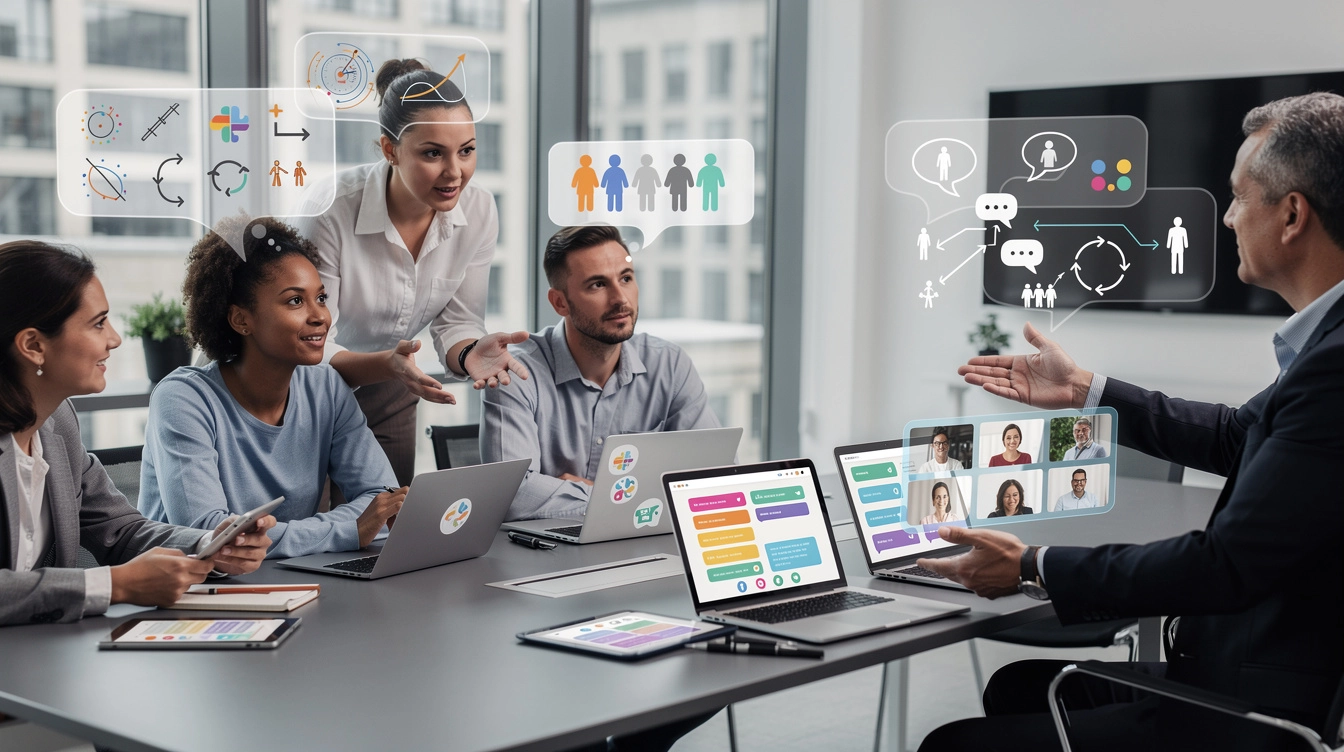
Modern workplace collaboration faces unprecedented challenges as teams navigate hybrid work environments, diverse communication preferences, and rapidly evolving digital tools. The foundation of successful teamwork lies not in sophisticated technology alone, but in developing robust communication habits that foster genuine connection and understanding among team members. Research consistently demonstrates that teams with strong communication practices achieve 25% higher productivity rates compared to their counterparts with fragmented communication approaches.
The evolution from traditional office-based collaboration to distributed work models has fundamentally altered how professionals interact, share knowledge, and build relationships. Understanding the psychological barriers that impede effective communication, optimising digital channels for maximum impact, and implementing structured methodologies for meaningful dialogue has become essential for organisational success. These elements form the cornerstone of collaborative excellence in contemporary business environments.
Psychological barriers to effective workplace communication
Human psychology significantly influences how team members process information, interpret messages, and engage in collaborative discussions. Understanding these underlying mechanisms enables leaders to design communication strategies that account for natural cognitive tendencies and biases that can derail productive teamwork.
Cognitive load theory in information processing and message retention
Cognitive load theory reveals why team members struggle to process complex information during meetings and collaborative sessions. When individuals receive excessive information simultaneously, their working memory becomes overwhelmed, leading to reduced comprehension and poor decision-making. This phenomenon particularly affects virtual meetings where participants juggle multiple information streams including visual presentations, audio commentary, and digital notifications.
Effective communication strategies must consider the three types of cognitive load: intrinsic load related to task complexity, extraneous load from poor presentation methods, and germane load required for learning and understanding. Teams that structure their communication to minimise extraneous cognitive load see improvements in information retention rates of up to 40%. This involves breaking complex topics into digestible segments, using visual aids strategically, and allowing processing time between information delivery phases.
Confirmation bias effects on Cross-Functional team discussions
Confirmation bias represents one of the most pervasive barriers to effective team communication, particularly in cross-functional environments where diverse perspectives should drive innovation. Team members naturally seek information that confirms their existing beliefs whilst dismissing contradictory evidence, leading to echo chambers that stifle creative problem-solving and comprehensive analysis.
This bias manifests strongly during brainstorming sessions where individuals with technical expertise may discount input from colleagues in different disciplines. Research indicates that cross-functional teams experiencing high confirmation bias demonstrate 30% lower innovation rates compared to teams that actively counteract this tendency. Successful mitigation strategies include structured devil’s advocate protocols, rotating discussion leadership among team members, and implementing pre-mortem analysis techniques that encourage exploration of potential failure scenarios.
Social loafing patterns in virtual team environments
Social loafing emerges when individual contributions become less identifiable within group settings, leading to reduced effort and engagement. Virtual team environments amplify this phenomenon as physical distance and technological barriers create additional anonymity layers. Studies demonstrate that virtual teams experience social loafing rates 35% higher than their in-person counterparts, significantly impacting collaborative outcomes.
The challenge intensifies in large virtual meetings where participants can easily disengage without immediate detection. Effective countermeasures include implementing individual accountability mechanisms, rotating speaking responsibilities, and creating smaller working groups within larger teams. Technology solutions such as participation tracking and contribution measurement tools help maintain engagement levels whilst preserving team member autonomy.
Dunning-kruger effect impact on knowledge sharing sessions
The Dunning-Kruger effect creates significant communication challenges when team members with limited expertise overestimate their knowledge whilst those with deep expertise underestimate their contributions. This cognitive bias disrupts knowledge sharing sessions as less experienced individuals dominate discussions whilst subject matter experts remain passive, assuming their insights are obvious to others.
This dynamic particularly affects technical teams where junior members may confidently propose solutions without fully understanding complexities that senior colleagues immediately recognise. Creating structured knowledge sharing protocols that explicitly encourage expert input whilst providing learning opportunities for developing team members helps balance participation levels. Mentorship programmes and paired collaboration sessions can effectively address these imbalances whilst fostering skill development across the team.
Digital communication channel optimisation strategies
The proliferation of digital communication tools creates both opportunities and challenges for
teams: while there is no shortage of channels, fragmented usage patterns, misaligned expectations, and tool fatigue often undermine their benefits. Optimising digital communication channels means being intentional about which tools you use, how you use them, and what behaviours you incentivise across the organisation. When teams treat channels as part of a designed system rather than ad hoc solutions, collaboration becomes more predictable, measurable, and far less stressful.
Slack workflow automation for asynchronous collaboration
Slack has become a default hub for many hybrid and remote teams, yet unmanaged channels and constant notifications can quickly lead to communication overload. Effective Slack usage for team collaboration starts with clear channel taxonomies (for example, #proj-, #dept-, #ops-) and explicit norms about what belongs where. Workflow automation then turns Slack from a noisy chat app into a structured collaboration layer that supports asynchronous work instead of interrupting it.
Practical automation patterns include routing key project updates from your project management tool into dedicated channels, using forms or simple slash commands to standardise requests, and building reminder workflows that nudge owners before deadlines rather than relying on manual follow-ups. For example, a workflow that asks a user three structured questions when they post an update (“What changed?”, “What’s the impact?”, “What do you need from others?”) reduces ambiguity and improves message retention. Teams that standardise these micro-interactions often report fewer status meetings because the information already lives in a searchable, structured format.
To prevent Slack from becoming a proxy email inbox, define “async-first” norms such as response-time expectations, do-not-disturb windows, and when to move from chat to a quick call. Encourage teams to thread conversations to preserve context, and use channel-level guidelines pinned at the top so newcomers can quickly understand how to participate. When Slack is optimised in this way, asynchronous collaboration supports focused deep work while still enabling rapid alignment when it truly matters.
Microsoft teams integration with project management platforms
Microsoft Teams is most powerful when integrated with existing project management platforms rather than used as a standalone chat and meeting tool. Many organisations underuse Teams by treating it purely as a video conferencing solution, missing the opportunity to embed tasks, documents, and decisions directly into their daily communication flows. Integrations with tools like Planner, Jira, or Asana bring work artifacts into the conversation space, reducing context switching and information loss.
Effective Teams-based collaboration hinges on creating channels that map cleanly to projects, products, or initiatives and then surfacing the relevant project boards, dashboards, and files in tabs within those channels. When a meeting is scheduled in Teams, attaching the relevant board or document as a tab ensures participants can move from discussion to decision to task creation within a single environment. This “conversation-to-execution” continuity is especially valuable for distributed teams managing complex initiatives.
Leaders should also establish clear guidelines for when a conversation results in a task and where that task should live. For instance, you might decide that any action requiring more than 15 minutes of work becomes a ticket in your project tool, created directly from the Teams thread. Over time, this discipline builds a reliable trail from decisions to deliverables, making it easier to audit work, understand dependencies, and assess communication effectiveness in project outcomes.
Notion database architecture for cross-departmental knowledge management
While chat tools are essential for day-to-day collaboration, sustainable team communication relies on a robust knowledge management system. Notion’s flexible database architecture makes it well-suited for building a “single source of truth” that spans departments, projects, and processes. However, without deliberate design, Notion workspaces can become digital junk drawers that are as confusing as scattered file shares.
High-performing teams treat Notion as a workplace operating system, starting with a small set of core databases: Projects, Tasks, People, Knowledge base, and Meetings. Each database uses consistent properties such as owners, status, tags, and relationships, enabling cross-departmental reporting and simplified navigation. For example, a “Projects” database linked to a “Knowledge base” database ensures that project pages automatically surface related documentation, decisions, and retrospectives.
To reduce cognitive load for everyday users, create opinionated templates for recurring artefacts: project briefs, meeting notes, decision logs, and runbooks. Each template should embed prompts that reinforce good communication habits, such as sections for “Context”, “Risks and assumptions”, and “Decisions made”. When every department uses the same structures, you dramatically reduce the time it takes for team members to understand what they are looking at and how to contribute, which in turn improves cross-functional collaboration and message retention.
Zoom breakout room configuration for structured brainstorming
Zoom and similar video platforms have become central to remote collaboration, but unstructured large-group calls often lead to disengagement and shallow contributions. Breakout rooms, when configured thoughtfully, transform Zoom from a presentation tool into a powerful environment for structured brainstorming and decision-making. The key lies in pairing thoughtful facilitation with technical configuration.
For ideation sessions, pre-configure breakout rooms around themes or questions rather than random grouping. Assign a facilitator and a note-taker in each room, and provide a shared canvas or document for capturing ideas. Timeboxed rounds (for example, three cycles of 10–15 minutes) with clear prompts encourage participants to move from divergent thinking (“generate as many ideas as possible”) to convergent thinking (“prioritise the top three options”). This mirrors in-person workshop techniques and counteracts social loafing by giving everyone a role.
To support psychological safety in remote brainstorming, consider enabling anonymous input in parallel tools (such as shared whiteboards or forms) while still using breakout discussions for verbal exploration. Rotate participants between rooms in later rounds to cross-pollinate ideas, and always allocate time at the end to synthesise insights in the main room. When teams consistently use structured breakout configurations instead of ad hoc discussions, remote meetings become more inclusive, more energising, and far more productive.
Active listening methodologies for remote team dynamics
Active listening is often discussed as a soft skill, yet in remote team dynamics it becomes a hard requirement for effective collaboration. Without the full spectrum of in-person cues, misunderstandings multiply and minor misalignments can snowball into major project risks. Implementing structured active listening methodologies helps distributed teams maintain clarity, reduce rework, and preserve trust even when they rarely share a physical space.
One practical approach is to normalise “listen-first” rituals in virtual meetings. For instance, after a complex update, you can ask one or two participants to summarise what they heard before discussion begins. This simple echoing technique reveals gaps in understanding and forces everyone to process information rather than passively consume it. Over time, it builds a culture where comprehension is valued as much as contribution.
Remote teams also benefit from adopting explicit turn-taking and reflection techniques, particularly in emotionally charged or high-stakes conversations. Practices such as the “round-robin check-in” at the start or end of a call ensure that quieter voices are heard. For asynchronous channels, active listening translates to practices like paraphrasing key points in follow-up messages, asking clarifying questions instead of making assumptions, and signalling when you have fully read and understood a long update (for example, with a short summary reply).
Think of active listening as the bandwidth of your human network: no matter how many collaboration tools you deploy, if messages are only half-heard or half-understood, effective capacity is cut in half. Investing in listening training, coaching managers on reflective questioning, and modelling curiosity (“What am I missing?”) are some of the highest-leverage steps you can take to improve communication and collaboration across remote and hybrid teams.
Nonviolent communication framework implementation in agile workflows
Agile workflows are built on frequent feedback, rapid iteration, and continuous improvement, which means communication intensity is inherently high. Without a deliberate framework, feedback can easily be perceived as criticism, sprint rituals can devolve into blame sessions, and collaboration can suffer. The Nonviolent Communication (NVC) framework offers a structured way to keep discussions constructive and human-centred, even under delivery pressure.
NVC focuses on four components: observations, feelings, needs, and requests. In an agile context, this might translate to a team member saying, “In the last sprint review, I noticed we discussed three bugs for over 30 minutes each (observation). I felt frustrated and rushed (feeling) because I need enough time to plan the next sprint properly (need). Could we timebox bug discussions and capture deeper analysis as follow-up tasks (request)?” This approach keeps feedback specific, de-personalised, and action-oriented.
To embed Nonviolent Communication into agile team communication, start by introducing the framework in a workshop and then weaving it into existing ceremonies. For example, you can dedicate a portion of retrospectives to practising NVC statements around what worked and what did not. Scrum Masters and agile coaches can model NVC when mediating conflicts or clarifying priorities, gradually making it the “default language” for difficult conversations.
Over time, NVC reduces defensiveness and helps teams separate people from problems, which is critical for complex collaboration. When engineers, product managers, and stakeholders feel safe expressing concerns without triggering conflict, they are more likely to surface risks early, admit uncertainty, and co-create better solutions. In this way, NVC becomes not just a communication technique but a foundational habit that improves both team morale and delivery outcomes.
Meeting facilitation techniques using the liberating structures methodology
Many teams experience meeting fatigue because discussions default to open, unstructured formats dominated by a few voices. Liberating Structures is a facilitation methodology that replaces traditional meeting patterns with simple, repeatable structures designed to democratise participation and accelerate meaningful outcomes. When applied consistently, these techniques transform routine meetings into dynamic collaboration sessions where every participant contributes.
1-2-4-all pattern for inclusive idea generation
The 1-2-4-All structure is a powerful antidote to groupthink and social loafing in both in-person and virtual meetings. It begins with one minute of silent reflection (1), followed by two minutes of discussion in pairs (2), then four minutes in groups of four (4), and finally a whole-group share-out (All). This pattern ensures that everyone has time to think independently before being influenced by others, while also giving quieter team members a safer space to voice ideas.
In practice, you might use 1-2-4-All to refine sprint goals, generate solutions to a persistent blocker, or design improvements to your onboarding process. In virtual settings, breakout rooms can be configured to support the 2 and 4 stages, with a shared document or whiteboard capturing insights at each level. By the time the discussion returns to the full group, ideas are already refined and clustered, which makes decision-making faster and more inclusive.
From a communication perspective, 1-2-4-All builds a muscle for moving between individual reflection and collective synthesis. Instead of defaulting to long monologues or open-floor debates, teams learn to work in deliberate cycles of divergence and convergence. This rhythm not only improves the quality of ideas but also reinforces the habit of giving everyone a voice in collaborative problem-solving.
Open space technology for self-organising team discussions
Open Space Technology (OST) is a facilitation method designed for complex topics where the right questions and participants are not fully known in advance. Rather than imposing a fixed agenda, OST invites participants to co-create the topics they care about, then self-organise into sessions based on interest and expertise. This approach is particularly effective for cross-functional teams tackling broad themes such as “improving remote onboarding” or “reducing release risk.”
In an OST session, participants propose discussion topics, which are then scheduled into time slots and virtual or physical spaces. A simple “law of two feet” (or its virtual equivalent) empowers individuals to move between sessions where they feel they can contribute or learn the most. This fluid movement may seem chaotic compared to traditional meetings, but it often produces higher engagement and more relevant outcomes because energy and ownership come from the participants themselves.
For digital-first organisations, OST can be adapted using shared boards to capture topics, virtual breakout rooms for sessions, and collaborative documents for notes. The key communication benefit is that authority and airtime are distributed, allowing hidden expertise and perspectives to surface. Leaders gain insight into what truly matters to their teams, while participants experience a level of autonomy that strengthens commitment to the resulting actions.
Appreciative inquiry protocols for conflict resolution
When teams face conflict or underperformance, the instinct is often to focus on problems and root causes. Appreciative Inquiry (AI) offers a complementary approach centred on discovering and amplifying what already works. Rather than asking, “Why is communication so broken on this project?”, AI prompts questions such as, “When have we communicated well under pressure, and what was different about those moments?” This shift from deficit to strength-based inquiry has a profound effect on how teams collaborate through challenges.
AI typically follows a 4-D cycle: Discover, Dream, Design, and Destiny. In a conflict resolution context, you might first invite team members to share stories of effective collaboration (Discover), then envision what ideal communication would look like on the current project (Dream). From there, the team co-designs specific practices or agreements (Design) and commits to experiments that bring the vision to life (Destiny). Each step reinforces constructive dialogue instead of blame.
As a communication habit, Appreciative Inquiry trains teams to ask better questions and to look for possibilities rather than constraints. This does not mean ignoring problems; instead, it reframes them in a way that keeps conversations energising and future-oriented. Over time, AI protocols can be woven into retrospectives, performance reviews, and even one-on-ones, creating a culture where learning and improvement are closely tied to recognition of strengths.
World café method for large group strategic planning
The World Café method is designed for large-group dialogue on strategic or systemic questions, such as shaping a product roadmap or defining collaboration principles for an entire department. Participants rotate between small tables (or virtual breakout rooms), each focused on a specific question related to the overarching theme. After several rounds, insights are harvested in a plenary session, revealing patterns and shared priorities that might not emerge in traditional top-down planning meetings.
In a World Café for communication and collaboration, questions might include “What practices help us feel most connected across time zones?” or “What gets in the way when we try to share knowledge between teams?” A host remains at each table to brief new arrivals on previous conversations, ensuring continuity while also welcoming fresh perspectives. Visual capture tools—such as digital murals or collaborative documents—help synthesise themes across rounds.
Because World Café emphasises curiosity, listening, and cross-pollination of ideas, it naturally counters silos and hierarchy. Participants see their ideas reflected in the final themes, which increases buy-in for subsequent changes. Used periodically, this structure gives organisations a scalable way to align large, distributed groups around shared communication norms and collaboration strategies without relying on one-way presentations.
Performance metrics for communication effectiveness assessment
Improving communication habits is only sustainable when teams can see and measure the impact of their efforts. While qualitative feedback remains essential, quantitative metrics provide an objective lens on whether changes in communication are translating into better collaboration and outcomes. The goal is not to track every message, but to identify a small set of meaningful indicators that link communication practices to business results.
Useful metrics span three broad categories: process, perception, and performance. Process metrics might include meeting duration and frequency, percentage of meetings using structured facilitation methods, or adoption rates of agreed communication norms (such as documented agendas and notes). Perception metrics come from pulse surveys that ask team members how clear they find updates, how psychologically safe they feel speaking up, or how well cross-functional communication supports their work.
Performance metrics connect communication effectiveness to tangible outcomes: reduction in rework due to miscommunication, faster cycle times for cross-team dependencies, or higher project success rates when using specific collaboration practices. For instance, you might compare defect rates or on-time delivery percentages before and after introducing structured daily stand-ups or active listening training. Over time, these comparisons reveal which habits truly move the needle.
To avoid turning communication into a surveillance exercise, involve teams in designing the metrics and reviewing the data. Ask questions such as, “What would tell us that our new meeting habits are working?” or “How will we know if asynchronous updates are actually reducing interruptions?” When teams co-own both the measures and the improvement experiments, metrics become a tool for learning rather than control.
Ultimately, effective communication is less about any single tool or framework and more about the consistent habits that shape how people interact every day. By understanding psychological barriers, optimising digital channels, adopting active listening, applying empathetic frameworks like Nonviolent Communication, and using Liberating Structures for facilitation—then measuring their impact—you create a communication ecosystem where collaboration can reliably flourish.