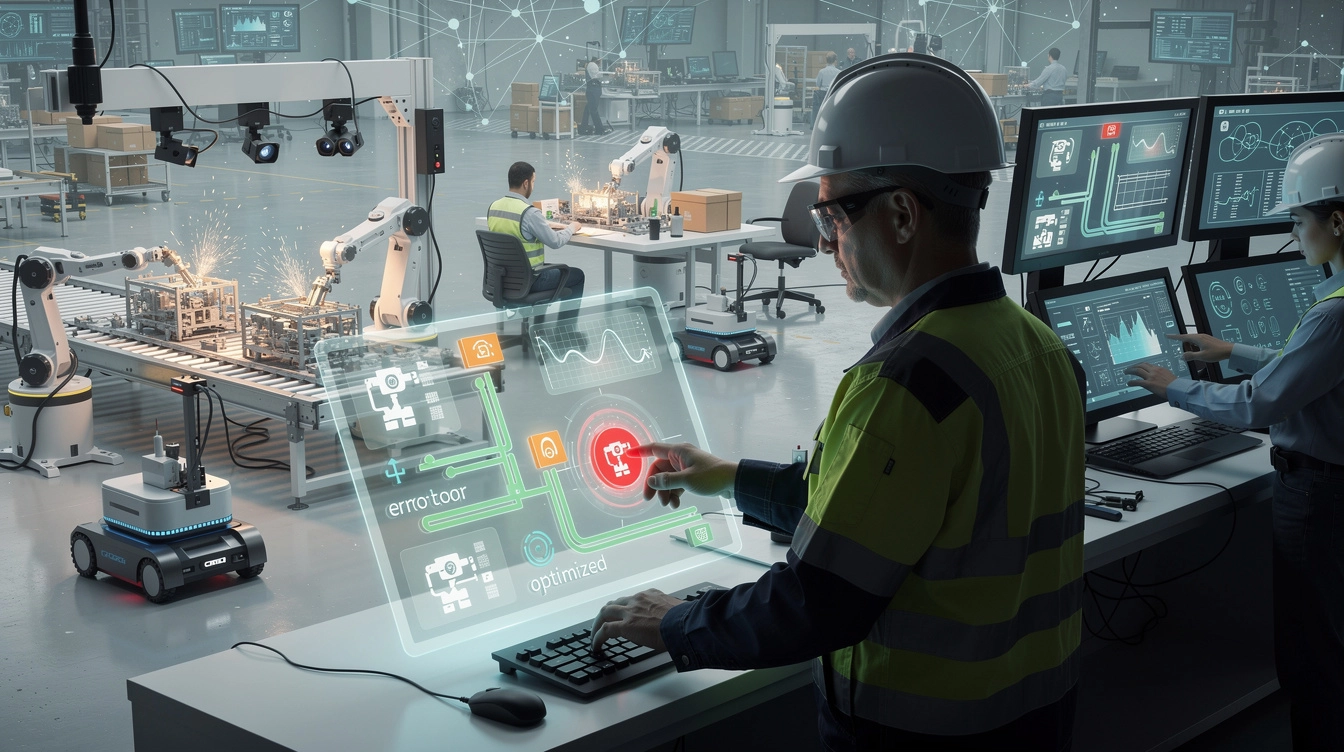
# Reducing Human Error Through Smart Automation Systems
Manufacturing and industrial operations have long grappled with a fundamental challenge: the inherent variability of human performance. Even the most skilled operators experience fluctuations in concentration, decision-making accuracy, and physical precision throughout their shifts. These variations, whilst natural, create significant operational risks across production lines, quality control checkpoints, and critical safety systems. The financial impact is staggering—recent industry analysis reveals that human error contributes to approximately 70% of unplanned downtime in manufacturing environments, translating to billions in lost productivity annually. Smart automation systems now offer a transformative approach to this persistent challenge, not by eliminating human expertise, but by strategically deploying technology where consistency, speed, and precision matter most. The integration of robotic process automation, machine learning algorithms, and intelligent sensor networks creates operational frameworks that amplify human capability whilst systematically reducing error probability across the entire production ecosystem.
Understanding cognitive load theory and human error probability in industrial operations
Cognitive load theory provides essential insights into why even experienced operators make mistakes during routine industrial tasks. The human brain processes information through working memory, which has strictly limited capacity—typically holding only 7±2 information chunks simultaneously. When operators must monitor multiple parameters, respond to alarms, make time-sensitive decisions, and maintain situational awareness across complex systems, their cognitive resources become overwhelmed. This mental saturation increases error probability exponentially, particularly during shift transitions, emergency scenarios, or when managing unfamiliar equipment configurations.
Industrial psychologists have quantified this phenomenon through Human Error Probability (HEP) calculations, which assess the likelihood of mistakes under varying operational conditions. Research demonstrates that HEP increases by 300-400% when operators multitask between three or more concurrent activities. Environmental stressors further compound this issue—inadequate lighting raises error rates by 25%, whilst noise levels exceeding 85 decibels impair decision-making accuracy by approximately 15%. Temperature extremes, shift work patterns, and time pressure create additional cognitive burdens that predictably degrade human performance.
Smart automation addresses these vulnerabilities by assuming responsibility for high-cognitive-load activities. Advanced control systems continuously process thousands of data points per second, maintain perfect attention spans indefinitely, and execute complex calculations without mental fatigue. This redistribution of cognitive burden allows human operators to focus their irreplaceable skills—pattern recognition, strategic thinking, and adaptive problem-solving—on oversight and optimisation rather than routine execution. The result is a hybrid operational model where technology handles cognitive overload whilst preserving human judgment for scenarios requiring contextual understanding and creative intervention.
Robotic process automation (RPA) implementation using UiPath and blue prism
Robotic Process Automation has emerged as a cornerstone technology for eliminating repetitive, rules-based errors across manufacturing and administrative workflows. Leading platforms such as UiPath and Blue Prism enable organisations to deploy software robots that interact with existing systems precisely as human users would—clicking interface elements, extracting data, performing calculations, and triggering subsequent actions. Unlike traditional programming approaches requiring extensive system integration, RPA bots operate at the presentation layer, making deployment remarkably swift and minimally disruptive to established IT infrastructures.
The financial services sector has documented particularly impressive results, with RPA implementations reducing transaction processing errors by 95% whilst accelerating throughput by 60-80%. Manufacturing organisations applying similar technologies to inventory management, production scheduling, and quality documentation report comparable improvements. A European automotive manufacturer recently deployed Blue Prism bots to automate bill-of-materials verification across 14 production facilities, eliminating data entry errors that previously caused approximately £2.3 million in annual rework costs. The bots validate component specifications against engineering databases, flag discrepancies for human review, and maintain perfect accuracy across millions of monthly transactions.
Attended vs unattended bot deployment strategies for manufacturing workflows
Manufacturing environments benefit from strategic deployment of both attended and unattended RPA configurations, each addressing distinct error reduction opportunities. Attended bots function as intelligent assistants that activate on-demand when operators require support with complex procedures. During changeover operations, for example, attended bots can guide technicians through multi-step equipment reconfiguration sequences, automatically populate parameter fields with validated settings, and perform real-time verification checks that prevent configuration mistakes. This collaborative approach reduces setup errors by 70-85% whilst preserving human control over
control over critical decisions.
Unattended bots, by contrast, execute end-to-end workflows with minimal or no human intervention, typically running on virtual machines or dedicated servers. In manufacturing, these bots can automate nightly data reconciliation between MES, ERP, and warehouse management systems, generate production reports, and trigger replenishment orders based on predefined thresholds. Because unattended bots operate 24/7 and follow strict rule sets, they remove variability caused by shift patterns and fatigue, achieving error reduction rates of 90–95% in highly standardised processes. An effective automation strategy often combines both approaches: attended bots embedded at operator workstations to support high‑cognitive‑load tasks, and unattended bots orchestrating background activities that must run consistently and reliably at scale.
Deciding where to use attended versus unattended RPA hinges on process criticality, exception frequency, and the need for contextual judgment. High-variability tasks with frequent edge cases, such as engineering change management, tend to benefit from attended bots that keep humans “in the loop.” Highly repetitive, rules-based workflows like label generation, automatic data uploads, and compliance logging are prime candidates for unattended execution. By mapping each step of a manufacturing workflow to these deployment models, organisations can create a layered defence against human error that still respects regulatory requirements and operational realities.
Document intelligence and optical character recognition error reduction
Document-heavy environments are particularly vulnerable to human error, especially when operators must manually transcribe or verify information from paper-based forms, supplier certificates, or legacy printouts. Modern document intelligence solutions, combined with Optical Character Recognition (OCR), dramatically reduce these risks by converting unstructured documents into structured, machine-readable data. When integrated into RPA platforms such as UiPath Document Understanding or Blue Prism Decipher, OCR engines can achieve up to 99.9% character recognition accuracy under good image conditions, far exceeding typical manual data entry performance.
In practical terms, this means that certificates of analysis, delivery notes, and maintenance checklists can be scanned, interpreted, and validated automatically before being pushed into SAP or Oracle ERP. Advanced document intelligence models use machine learning to understand context—for instance, distinguishing between batch numbers, lot codes, and expiry dates even when layouts vary by supplier. This contextual understanding is crucial for reducing “silent errors,” such as transposed digits or misassigned fields, which often go undetected until they cause compliance breaches or product recalls.
To maximise error reduction, leading manufacturers implement multi-layer validation workflows where OCR outputs are cross-checked against master data or predefined business rules. For high-risk documents, systems can employ confidence thresholds: fields below a certain confidence score are routed to an attended bot interface for human confirmation, while high-confidence fields flow straight through. This hybrid approach balances automation efficiency with quality assurance, ensuring that document-related errors are systematically identified and addressed before they propagate downstream.
Exception handling protocols in SAP and oracle ERP integration
Even the most sophisticated RPA implementations will encounter scenarios that fall outside predefined rules, particularly when integrating with complex ERP environments like SAP S/4HANA or Oracle Fusion. Without robust exception handling protocols, these edge cases can reintroduce the very human errors automation is designed to eliminate. Smart automation systems therefore incorporate explicit exception taxonomies, routing logic, and escalation paths that determine how anomalies are detected, classified, and resolved.
Typical exceptions in ERP-integrated workflows include missing master data, conflicting inventory balances, unexpected system responses, and network timeouts. UiPath and Blue Prism bots can be configured to log these anomalies in structured formats, capture screenshots, and tag relevant transaction IDs before suspending the affected process. Integration with IT service management tools such as ServiceNow or Jira allows exceptions to be converted into tickets with all necessary diagnostic information attached, reducing the cognitive load on support teams and shortening resolution times by 30–50%.
Crucially, exception handling design should differentiate between “business exceptions” and “system exceptions.” Business exceptions—such as price mismatches or out-of-tolerance quality readings—are often routed to domain experts for decision-making, with the bot resuming execution once guidance is provided. System exceptions, on the other hand, may trigger automatic retries, failover routines, or alternative execution paths. By treating exceptions as first-class citizens in SAP and Oracle ERP automations, organisations build resilience into their processes and prevent small anomalies from cascading into large-scale operational disruptions.
Process mining with celonis for identifying high-risk manual touchpoints
Before you can automate to reduce human error, you must first understand where that error is most likely to occur. This is where process mining platforms like Celonis deliver exceptional value. By analysing event logs from ERP, MES, and CRM systems, Celonis reconstructs actual end-to-end workflows—often revealing substantial divergence from documented procedures. These “process variants” expose where manual workarounds, rework loops, and bottlenecks introduce unnecessary risk.
For instance, a process mining analysis might reveal that 18% of purchase orders are manually adjusted after initial creation, or that quality deviations often correlate with specific shift patterns or suppliers. Celonis quantifies the frequency and impact of these deviations, enabling teams to prioritise which manual touchpoints warrant automation first. In many deployments, organisations uncover that a small number of high-risk activities—often less than 10% of all steps—account for a disproportionate share of errors, delays, and compliance issues.
Once these high-risk manual touchpoints are identified, RPA and workflow automation can be targeted with surgical precision. Celonis’ execution management capabilities even allow for “closed-loop” automation, where process insights trigger bots directly to correct deviations in real time—for example, auto-correcting routing decisions or enforcing mandatory approval steps. This data-driven approach ensures that automation investments focus on the most impactful error sources, rather than relying on anecdotal perceptions of where problems might exist.
Machine learning anomaly detection in quality control systems
Traditional quality control relies heavily on predefined thresholds and manual inspections, which are both prone to oversight and limited in their ability to detect subtle, emerging patterns. Machine learning-based anomaly detection offers a more adaptive, data-driven approach, continuously learning what “normal” looks like across production lines and flagging deviations before they manifest as defects or failures. By ingesting data from sensors, vision systems, and historical quality records, these models can identify complex multivariate relationships that would be impossible for humans to track in real time.
Studies in advanced manufacturing environments show that machine learning anomaly detection can reduce scrap rates by 20–40% and detect drift conditions hours or even days before conventional SPC charts would signal a problem. This early warning capability is particularly valuable in continuous or high-volume processes, where undetected variations can generate large quantities of off-spec product. In effect, anomaly detection serves as a digital “sense organ,” augmenting human quality engineers with always-on pattern recognition that never tires or loses focus.
Supervised learning models for defect pattern recognition
Supervised learning models excel when historical data includes labelled examples of defects and non-defects. In such scenarios, algorithms like random forests, gradient boosting machines, and convolutional neural networks (CNNs) can be trained to distinguish between acceptable and faulty outputs with high precision. For example, in electronics assembly, supervised models can analyse solder joint images and classify them into categories such as “void,” “insufficient solder,” or “misalignment,” often achieving accuracy rates above 95% when trained on sufficient data.
The power of supervised learning lies in its ability to capture nuanced defect patterns that go beyond simple tolerance checks. Instead of relying solely on fixed upper and lower control limits, models learn from hundreds of variables—temperatures, pressures, cycle times, tool wear indicators—and their interactions. This holistic view reduces the risk that a combination of borderline conditions will slip past traditional rules-based systems. As new defect types emerge, labelled examples can be fed back into the training pipeline, allowing models to evolve alongside process changes.
To operationalise these models, many organisations embed them directly into MES or quality management systems, where predictions can trigger automatic actions. High-risk batches might be routed to additional inspection, while low-risk items flow through with minimal human intervention. By tiering inspection intensity based on predicted defect probability, plants can cut inspection effort by 30–50% while simultaneously reducing escapes, creating a virtuous cycle of efficiency and quality improvement.
Real-time computer vision applications using TensorFlow and OpenCV
Computer vision has become a cornerstone of modern quality control, particularly when combined with frameworks like TensorFlow and OpenCV. These technologies enable real-time image capture and analysis on production lines, turning cameras into intelligent sensors that detect misalignments, surface defects, incorrect assemblies, or missing components in milliseconds. Compared with manual visual inspection—which is notoriously susceptible to fatigue and inconsistency—vision systems provide consistent scrutiny around the clock.
TensorFlow models, often built using deep CNN architectures, can be trained to recognise specific visual features or anomalies. Once deployed, they run on edge devices or GPU-enabled servers, processing video streams in real time. OpenCV complements this by handling pre-processing tasks such as image enhancement, background subtraction, and geometric corrections, ensuring that models receive clean, standardised inputs. Together, these tools allow manufacturers to create robust, automated inspection stations that adapt to variations in lighting, orientation, or minor product differences.
A practical example is an automotive assembly line where computer vision verifies that every bolt, clip, and harness is present and correctly positioned before a vehicle advances to the next station. Instead of relying on a human to scan dozens of points in seconds, a vision system checks each frame against a trained model, highlighting discrepancies immediately on an HMI or andon board. This reduces rework, prevents safety-critical omissions, and offers granular traceability of inspection outcomes for each unit produced.
Predictive maintenance algorithms reducing operator intervention
Unplanned equipment failures not only disrupt production but also create high-pressure situations where human operators must improvise under stress—conditions that significantly increase human error probability. Predictive maintenance algorithms address this by forecasting failures before they occur, based on sensor data, historical breakdown records, and operating conditions. Techniques range from classical time-series analysis to advanced machine learning methods such as recurrent neural networks and anomaly detection ensembles.
By continuously monitoring vibration signatures, temperature profiles, acoustic emissions, and energy consumption, predictive models detect early indicators of wear or misalignment that operators might easily miss. When a model predicts a high likelihood of failure within a defined timeframe, maintenance tasks can be scheduled during planned downtime, with required parts and skills pre-arranged. This proactive approach reduces emergency interventions—where mistakes are most likely—and shifts work towards controlled, repeatable procedures supported by digital work instructions.
Industry benchmarks suggest that predictive maintenance can reduce unplanned downtime by up to 50% and extend asset life by 20–40%. Just as importantly, it stabilises the operating environment for human workers: fewer surprises, clearer schedules, and fewer high-stress “firefighting” scenarios. In this way, predictive maintenance is not only a reliability tool but also a powerful lever for reducing the cognitive load and error exposure of maintenance teams.
Natural language processing for automated compliance documentation
Compliance documentation—from batch records and deviation reports to audit trails and regulatory submissions—has traditionally been a labour-intensive, error-prone activity. Natural Language Processing (NLP) technologies now offer a way to automate large portions of this work, reducing transcription errors, omissions, and inconsistencies. By extracting key entities, events, and parameters from free-text logs, emails, and reports, NLP systems can populate structured compliance databases automatically.
For example, transformer-based models can scan maintenance logs to identify references to specific equipment, failure modes, corrective actions, and dates, then cross-link these to asset records in a CMMS or ERP. Similarly, NLP-powered templates can guide operators through deviation reporting, suggesting relevant root cause categories and corrective action options based on historical patterns. This not only speeds up documentation but also improves consistency in how incidents are described and classified, which is vital for regulators and auditors.
Moreover, conversational interfaces built on NLP can help operators query complex compliance rules in natural language—“What documentation is required after a Category 2 deviation on Line 3?”—and receive accurate, context-aware guidance. By embedding such assistants into HMIs or mobile devices, organisations reduce the risk that critical steps are skipped simply because workers are unsure of the correct procedure. The net result is a documentation ecosystem where human expertise is amplified, not replaced, and where the probability of paperwork-related non-conformances drops dramatically.
Industrial IoT sensors and SCADA system integration for error prevention
Industrial Internet of Things (IIoT) sensors and modern SCADA systems form the nervous system of smart factories, providing real-time visibility into equipment status, environmental conditions, and process variables. When properly integrated, they act as an early-warning network against conditions that typically precipitate human error—such as drift in critical parameters, unsafe operating states, or conflicting setpoints. Instead of relying on periodic manual checks or operator intuition, plants can monitor thousands of data points continuously and react before humans even perceive a problem.
IIoT architectures commonly involve edge devices that aggregate sensor data and perform preliminary analytics, sending only relevant information to central SCADA or cloud platforms. This reduces bandwidth consumption while enabling ultra-fast reaction times for safety-critical applications. For example, if a vibration sensor on a pump exceeds a specified threshold, the edge device can trigger a local interlock within milliseconds, while simultaneously sending contextual data to the SCADA system for operator review. This multi-layer protection significantly reduces the chance that an operator will overlook a subtle but dangerous trend on a crowded display.
From an error reduction perspective, the real power of IIoT and SCADA integration lies in automated interlocks, soft limits, and guided responses. Operating envelopes can be defined not just for individual machines but for entire process chains, with SCADA logic preventing commands that would push the system into unsafe or unstable regimes. When operators attempt to issue potentially harmful instructions—such as bypassing a safety limit or starting equipment out of sequence—the system can either block the action or require multi-level confirmation. In effect, the control system becomes an intelligent guardian, catching mistakes at the point of execution.
Human-machine interface (HMI) design principles in siemens and rockwell automation platforms
Even the most advanced automation can be undermined by poor Human-Machine Interface design. HMIs built on Siemens WinCC, Rockwell FactoryTalk, and similar platforms serve as the primary lens through which operators perceive process status and issue commands. If information is cluttered, ambiguous, or visually overwhelming, cognitive load increases and the probability of misinterpretation or delayed response rises accordingly. Effective HMI design therefore plays a central role in any strategy to reduce human error in industrial environments.
Modern best practice emphasises high-performance HMI principles: minimalist graphics, limited but meaningful colour usage, clear hierarchy of information, and consistent navigation structures. Instead of “piping and instrumentation diagram” replicas filled with decorative 3D elements, high-performance HMIs focus attention on deviations from normal conditions. Trends, KPIs, and alarms are presented in context, allowing operators to answer a simple but critical question at a glance: “Is my process healthy, and if not, where should I look first?” By aligning HMI layouts across Siemens and Rockwell platforms, multi-line or multi-site operators can transfer their skills seamlessly, further reducing the risk of interface-induced errors.
Fail-safe mechanisms and redundancy architecture in critical control systems
In safety- and mission-critical operations, the design of fail-safe mechanisms and redundancy architectures determines how systems behave when something goes wrong—whether that “something” is a hardware fault, communication loss, or human mistake. Distributed control systems (DCS) and PLC platforms from Siemens and Rockwell often support redundant CPUs, network paths, and I/O modules, ensuring that a single failure does not compromise control. However, redundancy alone does not guarantee safety; it must be combined with fail-safe logic that defaults processes to the safest possible state under fault conditions.
For example, emergency shutdown systems are typically engineered so that any loss of power, signal, or communication leads valves to fail closed, motors to stop, and hazardous energy sources to de-energise. Safety PLCs using standards such as IEC 61508 and IEC 62061 implement certified function blocks for emergency stops, guard monitoring, and safe speed control. By codifying these behaviours in hardware and software, plants minimise the reliance on human reaction times during critical events, when stress and confusion would otherwise increase error likelihood.
Redundancy architectures also play a key role in mitigating configuration or programming errors. Techniques such as diversity (using different hardware or software implementations for the same safety function) and cross-checking (where independent channels must agree before an action is taken) help detect latent faults that might have slipped past testing. In this sense, well-designed redundancy is not just about availability; it is a deliberate strategy to catch both random failures and systematic human mistakes before they manifest as unsafe actions.
Cognitive ergonomics in touchscreen panel configuration
Cognitive ergonomics focuses on designing systems that align with human mental models, memory limits, and perceptual capabilities. In the context of touchscreen HMIs, this translates into careful choices about layout, interaction patterns, and information density. When operators must navigate through multiple screens, decipher inconsistent symbols, or hunt for critical controls, their cognitive load increases—and so does the probability of pressing the wrong button or overlooking an important trend.
Applying cognitive ergonomics begins with task analysis: understanding what decisions operators need to make, under what time constraints, and with which pieces of information. Frequently used controls and indicators should be placed in consistent, easily reachable locations, with clear labelling and adequate touch target sizes to prevent mis-taps, especially when gloves are worn. Grouping related controls and using progressive disclosure—showing detail only when needed—helps prevent screen clutter and supports faster comprehension.
Colour and motion must also be used judiciously. Instead of relying on colour alone to convey meaning (which can be problematic for colour-blind users), designers combine shapes, icons, and text cues. Dynamic elements such as flashing indicators are reserved for genuinely urgent conditions, preventing “alarm fatigue” at the visual level. By treating the touchscreen panel as a cognitive workspace rather than a mere collection of buttons, Siemens and Rockwell HMI designers can create interfaces that guide correct actions and make incorrect ones less likely or even impossible.
Alarm management rationalisation following ISA-18.2 standards
Alarm systems are intended to draw operator attention to abnormal conditions that require intervention. However, in many plants, poorly configured alarm systems generate thousands of messages per day, overwhelming operators and leading to missed critical alerts—a classic pathway to human error. The ISA-18.2 standard provides a framework for alarm management rationalisation, ensuring that every alarm is necessary, actionable, and prioritised appropriately.
Rationalisation involves systematically reviewing each alarm to determine its purpose, cause, consequence, and required operator response. Alarms that do not meet clear criteria—such as those that do not demand human action—are downgraded to events or removed entirely. Remaining alarms are assigned priorities based on risk, with limits on how many high-priority alarms can be active simultaneously. When implemented within Siemens and Rockwell platforms, this process often reduces alarm volumes by 50–80%, dramatically decreasing the likelihood that critical messages will be lost in the noise.
In addition to static rationalisation, ISA-18.2 recommends dynamic alarm management strategies such as alarm shelving, state-based alarming, and suppression during maintenance. These techniques adapt alarm behaviour to current operating modes, preventing predictable “nuisance” alarms and focusing attention where it matters most. The end result is an alarm system that supports, rather than overwhelms, human cognition—providing clear, timely prompts for action and reducing the risk of both overreaction and inaction.
Measuring success: key performance indicators for automation-driven error reduction
Implementing smart automation systems is only half the journey; organisations must also measure whether these investments are truly reducing human error and improving operational resilience. To do this effectively, they need a set of targeted Key Performance Indicators (KPIs) that connect automation initiatives to tangible outcomes in safety, quality, productivity, and compliance. Without such metrics, it is difficult to distinguish between meaningful improvements and mere technological “noise.”
Core KPIs often include reductions in rework and scrap rates, decreases in unplanned downtime, and improvements in first-pass yield. Tracking near-miss incidents, safety violations, and process deviations before and after automation provides additional insight into how well error-prevention mechanisms are working. Many organisations also monitor “right-first-time” rates for transactions in ERP and MES systems, using these as proxies for administrative accuracy. By normalising these figures against production volume or operating hours, you can compare performance across lines, plants, or time periods in a fair and transparent way.
Leading manufacturers complement outcome metrics with process-focused indicators that capture how automation systems are behaving internally. Examples include bot success rates, exception volumes, mean time to resolution (MTTR) for automation incidents, and model drift indicators for machine learning systems. Monitoring alarm rates per hour per operator, average alarm response times, and the ratio of nuisance to genuine alarms offers a window into HMI and alarm management effectiveness. Together, these KPIs help identify when automation itself is becoming a source of complexity or error, prompting timely recalibration.
Finally, no measurement framework is complete without considering the human dimension. Surveys and interviews can gauge operator trust in automation systems, perceived cognitive load, and the frequency with which staff feel compelled to “work around” automated controls. In many high-performing plants, a reduction in informal workarounds and a rise in staff engagement are strong leading indicators that automation is aligned with real-world needs rather than fighting against them. By combining quantitative KPIs with qualitative feedback, organisations can ensure that their smart automation strategies deliver sustained, measurable reductions in human error while enhancing, rather than eroding, human expertise on the shop floor.